- *Corresponding Author:
- Mayank Pal
Pal’s Pet Clinic, Durg, Chhattisgarh, 491001, India
E-mail: drmayankpalvet@gmail.com
| Date of Received | 10 February 2026 |
| Date of Revision | 21 January 2026 |
| Date of Accepted | 10 February 2026 |
| Indian J Pharm Sci 2026;87(6):297-299 |
This is an open access article distributed under the terms of the Creative Commons Attribution-NonCommercial-ShareAlike 3.0 License, which allows others to remix, tweak, and build upon the work non-commercially, as long as the author is credited and the new creations are licensed under the identical terms
Abstract
Megaesophagus is a condition characterized by generalized dilation and reduced or absent motility of the esophagus, leading to ineffective transport of food and liquids from the mouth to the stomach. A dog diagnosed with megaesophagus and concurrent gastroesophageal reflux disease showed inadequate response to conventional proton pump inhibitor therapy. An off-label treatment regimen combining vonoprazan, a potassium-competitive acid blocker, and mosapride, a prokinetic agent, was initiated to achieve enhanced acid suppression and improve esophageal motility. Vonoprazan was administered orally at 1 mg/kg once daily, and mosapride at 1 mg/kg every 12 h. The combination therapy was well tolerated, with no adverse effects observed. Notably, the dog demonstrated a marked reduction in regurgitation frequency and improvement in clinical condition. This case suggests that vonoprazan, with its potent and sustained acid suppression, when paired with a prokinetic like mosapride, may offer a promising alternative for managing megaesophagus-associated gastroesophageal reflux disease in dogs unresponsive to standard therapy. Further studies are warranted to evaluate the safety, efficacy, and long-term benefits of this approach in veterinary patients.
Keywords
Megaoesophagus, gastr oesophageal reflux disease, vonoprazan, mosapride
Megaesophagus in dogs results in impaired esophageal clearance and predisposes affected animals to Gastroesophageal Reflux Disease (GERD), leading to esophagitis and worsening of clinical signs such as regurgitation and cough. Therapeutic management generally focuses on gastric acid suppression and enhancement of gastrointestinal motility. Proton Pump Inhibitors (PPIs) are routinely used in canine GERD; however, their delayed onset of action, requirement for acid activation, and variable efficacy can limit clinical response. Potassium-Competitive Acid Blockers (PCABs), including vonoprazan, provide rapid, potent, and sustained gastric acid suppression by reversibly inhibiting the H+, K+-ATPase independent of gastric pH, offering advantages over PPIs[1,2]. In human medicine, vonoprazan has demonstrated superior efficacy in healing reflux esophagitis, including PPI-resistant cases[3,4]. Mosapride, a selective 5-HT4 receptor agonist, enhances gastrointestinal motility by stimulating acetylcholine release within the enteric nervous system and has been shown to increase gastric motility in dogs at doses of 0.75-2 mg/kg without significant adverse effects[5,6]. To date, the combined use of vonoprazan and mosapride in dogs has not been reported.
An 8 y-old, 25 kg, female German shepherd dog was presented with frequent regurgitation, intermittent cough, and suspected esophagitis. Thoracic radiography and a positive-contrast esophagram (right lateral view) demonstrated marked, generalized esophageal dilation with retained barium, consistent with idiopathic megaesophagus (fig. 1). Initial management included dietary modification with a soft, slurry diet and acid suppression using omeprazole (1 mg/kg orally every 12 h). After 2 w of therapy, regurgitation frequency remained high and clinical improvement was minimal.
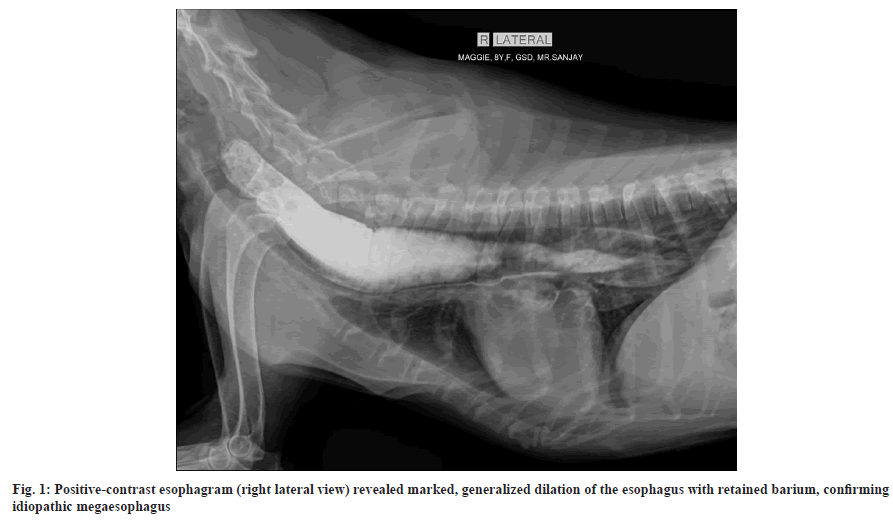
Fig. 1: Positive-contrast esophagram (right lateral view) revealed marked, generalized dilation of the esophagus with retained barium, confirming idiopathic megaesophagus
Due to the poor response, an off-label combination therapy was initiated consisting of vonoprazan (1 mg/kg orally once daily, administered 30 min before feeding) and mosapride (1 mg/kg orally every 12 h). The therapeutic rationale was to achieve more rapid and sustained acid suppression using a PCAB while concurrently enhancing esophageal clearance and gastric emptying through prokinetic stimulation.
Within 2 w of initiating combination therapy, the owner reported a marked reduction in regurgitation episodes, improved appetite, increased activity levels, and stabilization of body condition score. Postprandial coughing and gagging were notably reduced. Follow-up imaging findings were consistent with resolving esophagitis, with reduced mucosal erythema and erosions (fig. 2). No adverse drug reactions were observed during a 4 w follow-up period, and no episodes of aspiration pneumonia occurred.
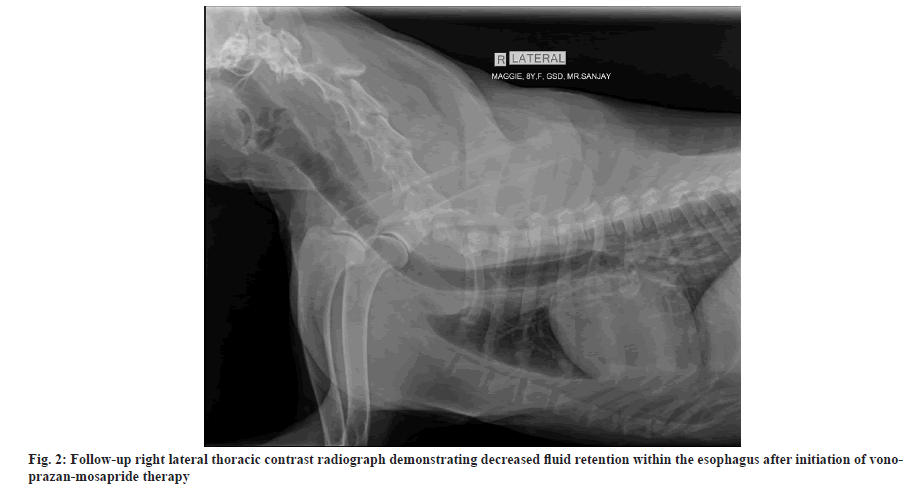
Fig. 2: Follow-up right lateral thoracic contrast radiograph demonstrating decreased fluid retention within the esophagus after initiation of vonoprazan- mosapride therapy
This case demonstrates the potential benefit of targeting two key pathophysiologic mechanisms involved in megaesophagus-associated GERD: Prolonged acid exposure and impaired motility. Vonoprazan provides rapid and sustained acid suppression via potassium-competitive inhibition of the gastric proton pump, an advantage over PPIs that require acid activation and may exhibit inconsistent efficacy in dogs. Mosapride enhances gastrointestinal motility through 5-HT4 receptor stimulation, promoting acetylcholine release and improving gastric emptying, which may secondarily aid esophageal clearance. The apparent synergistic effect of this dual approach likely contributed to the observed clinical improvement.
Although the use of vonoprazan and mosapride in this case was off-label, the combination was well tolerated and associated with meaningful clinical benefit. Given the limited veterinary literature on PCABs and the sparse data on prokinetic therapy in canine megaesophagus, controlled studies are warranted to establish optimal dosing regimens, long-term safety, and efficacy of PCAB–prokinetic combinations in dogs with refractory GERD.
In conclusion, the combination of vonoprazan (1 mg/kg once daily) and mosapride (1 mg/kg every 12 h) was safe and associated with significant clinical improvement in a dog with idiopathic megaesophagus and refractory GERD. This short communication highlights a promising therapeutic strategy that merits further investigation in larger canine populations.
Conflict of interests:
The authors declared no conflict of interests.
References
- Jenkins H, Sakurai Y, Nishimura A, Okamoto H, Hibberd M, Jenkins R, et al. Randomised clinical trial: Safety, tolerability, pharmacokinetics and pharmacodynamics of repeated doses of TAK‐438 (vonoprazan), a novel potassium‐competitive acid blocker, in healthy male subjects. Aliment Pharmacol Ther 2015;41(7):636-48.
[Crossref] [Google Scholar] [PubMed]
- Kagami T, Sahara S, Ichikawa H, Uotani T, Yamade M, Sugimoto M, et al. Potent acid inhibition by vonoprazan in comparison with esomeprazole, with reference to CYP 2C19 genotype. Aliment Pharmacol Ther 2016;43(10):1048-59.
[Crossref] [Google Scholar] [PubMed]
- Ashida K, Sakurai Y, Nishimura A, Kudou K, Hiramatsu N, Umegaki E, et al. Randomised clinical trial: A dose‐ranging study of vonoprazan, a novel potassium‐competitive acid blocker, vs. lansoprazole for the treatment of erosive oesophagitis. Aliment Pharmacol Ther 2015;42(6):685-95.
[Crossref] [Google Scholar] [PubMed]
- Hoshino S, Kawami N, Takenouchi N, Umezawa M, Hanada Y, Hoshikawa Y, et al. Efficacy of vonoprazan for proton pump inhibitor-resistant reflux esophagitis. Digestion 2017;95(2):156-61.
[Crossref] [Google Scholar] [PubMed]
- Kamiyama Y, Shinozaki K, Oishi R, Saeki K, Takeuchi T. Effects of mosapride citrate, a 5-HT4 receptor agonist, on gastrointestinal motility in conscious dogs. JPN J Pharmacol 1999;79(1):69-76.
- Tsukamoto H, Nagata T, Ueki S, Yamada K, Yoshida N, Nakamura K, et al. Effects of mosapride citrate on gastrointestinal motor activity and gastric emptying in dogs and humans. J Smooth Muscle Res 1999;35(2):93-104.